What to Give a Muslim at Their Baby's Funeral
Having gone through this start hand – after my sister and my best friend (who's also the co-founder of AYEINA) lost her son, it made me realize how important it is to know the formalities that come with the deceased. Peculiarly a child. Because nigh people don't know how the funeral of a child goes. They've by and large seen funerals of adults. And if you accomplish out, most people won't have the knowledge of how a funeral is carried out. Especially when it comes to its applied application.
Although we read the topic of death in detail and even took its exams when nosotros were doing our Qur'an course. But there nosotros were, frantically going through the pages of the book ( "mera jeena mera marna" – a book in Urdu ) while trying to absorb the reality of expiry. We had forgotten some parts considering nosotros never got to apply the cognition nosotros were given. Even though it was a role of the course to practically teach the students all the funeral rites.
إِنَّا لِلَّهِ وَإِنَّا إِلَيْهِ رَاجِعُونَ
Get listen to the audio linked in the Arabic text above. "Indeed we belong to Allah , and indeed to Him nosotros will render" rang true in so many ways. Because death – it waits for none. No matter how immature, no matter how former.
It's the worst nightmare for whatsoever parent out there only information technology's a reality so many parents around the world go through. Parents in Syria, Palestine, Kashmir, Rohingya among many others, face such calamities every day. Some even multiple times a mean solar day.
It takes some fourth dimension to swallow the bitter pill of reality – especially if the news come to you lot unexpectedly. Everything around you becomes so irrelevant and unimportant. The world starts to experience like an actual temporary place to alive in. Something that nosotros often forget amongst all the luxuries.
The term "what will the people say" get an extinct thought at that moment. You don't care how you wait similar or the unanswered notifications adding up in your mobile. You don't intendance well-nigh anything worldly at that moment.
And it's that moment when y'all're the well-nigh vulnerable and your tongue could say annihilation that Allah may dislike for you lot. Hence the showtime step after knowledge of such incident is:
1) Patience at starting time stroke of calamity
Accepting that expiry tin come up to anyone anytime is the first step towards existence able to do patience at the first blow of such calamity.
The Prophet (ﷺ) said, "The real patience is at the first stroke of a calamity." [ Bukhari ]
Tears are a completely natural phenomenon in grief whereas crying out loud and wailing are contrary to patience and are not permissible.
ii) Alhamdulillah 'ala kulli haal
In that moment, you lot may hear people consoling you with all sorts of words. Some may say things that may be displeasing to Allah and staying grateful in all circumstances becomes harder that style.
Remember that the innocent souls of children will directly go to Jannah in shaa Allah – without whatsoever questions asked. That'south i part of satisfaction you take when you lot lose a child. You know that they are in meliorate hands than yours. Better embrace than yours. Better care than you could provide. And definitely, a ameliorate place than this world has to offering.
I wrote on the topic of miscarriage beforehand every bit well after my sister went through that difficult phase. You can read it Hither:
Finding Hope in Miscarriage as a Muslim
Later a calendar week or so, I gave my sister the gratitude periodical to fill in. Considering the moments where gratitude seems the virtually hard, are the moments that really carry survival in gratitude. Without it, nosotros're surrounded by darkness over darkness. In that location seems no fashion out of the grief. Although she had been much stronger than all of us combined alhamdulillah, writing positive thoughts downwardly out of an credible negative scenario tin be therapeutic…
iii)Delegating tasks to unlike people
Preparing the torso for burying is a Fard Kifaayah – A communal obligation on Muslims. You may be extremely clueless at what to do and so it's natural to ask someone to delegate tasks to other people because Prophet (ﷺ) said:
أَسْرِعُوا بِالْجَنَازَةِ
"Hasten at a funeral, for if (the dead person) is good, you would (soon) bring him close to the good. And if it is otherwise, information technology is an evil of which y'all are ridding yourselves". [ Muslim ]
Hence yous can ask your loved ones for things like:
1) informing close people around – those who can help and offer a warm shoulder.
two) closing eyes/rima oris of the deceased.
iii) taking the body to a identify where one may need to give the ghusl and wrap in a shroud etc. – most probably your home (if y'all aren't already at that place).
four) arranging the kafur (camphor)/lote-tree (sidr) leaves etc. for the ghusl.
five) bringing the kafan/shroud (burial sheets).
( we got our shroud pack from Alhuda )
half-dozen) sending a person to the graveyard so a child'south grave may be dug.
7) request the mosque's Imam nearby for the funeral prayer timings etc.
Although generally, the relatives of the deceased must hasten in paying dorsum any debts from any wealth the deceased has left behind but of course, for a child – that'southward not required.
iv) Giving bath to the deceased
As a general rule, males should take the responsibility of washing males, and females should wash females. The merely exception to this rule is in the case of husband and wife, or small children.
This and all the next steps are probably the scariest of all.
When y'all touch a torso that has turned cold, it makes you realize the worth of a soul. The vessel that holds it turns into a scary reminder of expiry as you arrange a table to lay the body of the child on with your trembling hands and do ablution (wudu) to give the deceased a bath.
The procedure of 'ghusl' includes:
1) Removing the clothes (and cutting whatsoever habiliment is difficult to remove) and keeping the body parts that are not existence done – covered with a towel/open cloth piece.
two) Applying slight pressure to the abdomen to expel any impurities.
3) Washing the private parts.
four) Washing the parts of the body that are washed in wudu.
5) Pouring water on right side of the body and then the left – 3 , 5 or 7 times – starting time with sidr (lote-tree) leaves and the final washing should have some perfume in it, such as camphor or the similar.
Narrated Um 'Atiyya al-Ansariya: Allah's Messenger (ﷺ) came to us when his girl died and said, "Wash her thrice or five times or more, if you meet it necessary, with water and Sidr and and so apply camphor or some camphor at the end; and when y'all finish, notify me." So when nosotros finished information technology, we informed him and he gave us his waist-sheet and told us to shroud the dead body in it. [ Bukhari ]
vi) Drying the body/Clipping the nails/combing the hair etc. to go the body ready for shrouding.
v) Shrouding the expressionless body
Nothing reminds y'all of hereafter more than this step.
The Prophet (ﷺ) was shrouded in three sheets. The preferable color of the shroud is white.
Messenger of Allah (ﷺ) said, 'Clothing white dress because they are the purest and they are closest to modesty; and shroud the dead in it." [ Riyad equally-Salihin ]
It is non permissible to exist extravagant in shrouding the expressionless. The sheets should be ordinary material, and the number of sheets should non exceed three. Information technology is recommended that the shroud is perfumed with incense, except in the case of a person who died in a state of ihram.
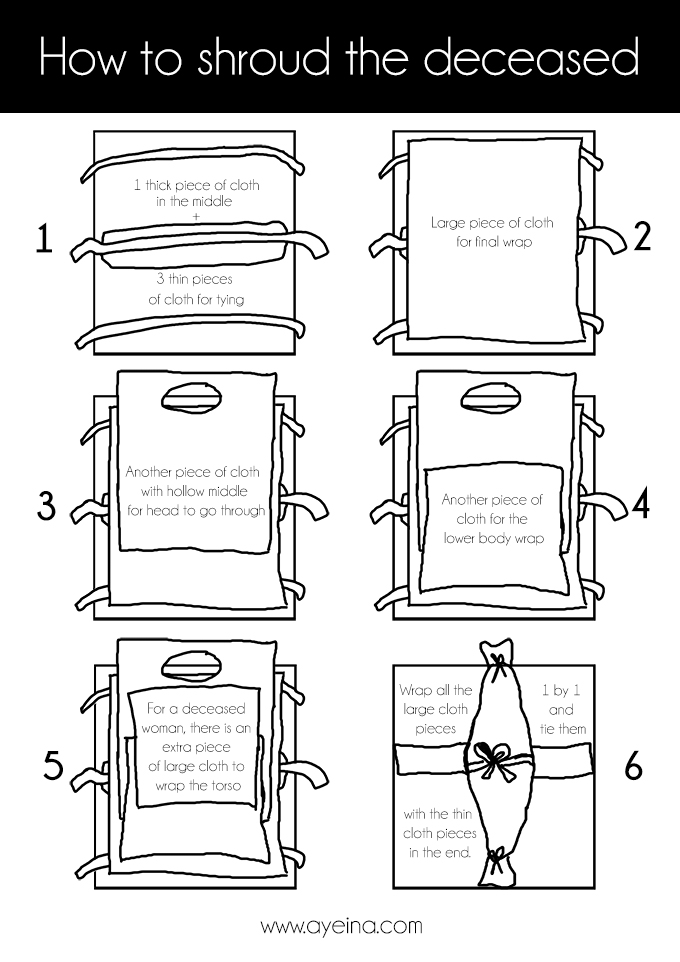
How to wrap a torso is the about confusing part – generally because your encephalon is really not present in that location and yous experience that your limbs are simply doing what they're supposed to practice at the given moment. Your mind is somewhere else – abroad from this dunya.
I've illustrated the following on my own with the assist of the illustration in the book "mera jeena mera marna" and translated it into English – Please feel free to impress it out. Hope information technology helps.
These links are also helpful alhamdulillah:
https://world wide web.youtube.com/sentinel?v=Y-DRwurgsfE
6) Offer the Funeral prayer
The shrouded trunk is then taken for Salaat-ul Janaazah which is a communal obligation – Fard Kifaayah.
Hence one can inform all those who tin can attend the funeral. Relatives living in the same city, neighbors etc. It likewise gives you a sense of community alhamdulillah. How people assemble when you need to hold the warm hands the most.
This is the moment when reality actually hits you and if y'all haven't shed tears all this time, the funeral prayer leaves your vulnerability wide open.
The funeral prayer is in the class of a congregation. The Imam stands facing the Qiblah behind the caput of the deceased man and behind the middle of the deceased woman.
Steps of the funeral prayer:
1) After the first takbir, Surat al-Fatihah is recited silently. It is also permissible to recite another small chapter after it (if the time allows).
ii) After the second takbir, the prayer for the Prophet (due south.a.westward) should be made.
3) After each of the remaining 2 or more takbirs, sincere prayers (du'a) are made for the deceased and their relatives. There are different invocations in sunnah only the easiest of all (something that you can memorize correct away) is:
أَللَّهُمَّ أَعِذْهُ مِنْ عَذَابِ الْقَبْرِ
Allahumma a'idhhu min 'adhab al-qabr – (O Allah, protect him from the torment of the grave).
iv) After the last takbir comes the tasleem – giving greetings of salaam, as one does in regular prayer (salaat) to conclude their prayer. One may exercise so by making tasleem to both the right and left sides, or the right side only.
vii) Burying the deceased
If you're a woman, you may not get to run across the deceased being buried half-dozen feet underground and then funeral prayer may feel similar a concluding goodbye.
Merely please make sure that you inform those who are burying the child (or fifty-fifty an adult) that the grave is not elevated or decorated with etched tombstones etc. What the deceased benefits from, are your duas.
Jabir said that he was forbidden to plaster graves. [ Muslim ]
The Messenger of Allah (ﷺ) forbade writing anything on graves. [ Ibn Majah ]
viii) Eating Tharid / Talbina
Well-nigh cultures effectually the world don't accept such customs hence no one may transport you lot the dish.
'A'isha the married woman of Allah's Apostle (ﷺ) said: When there was any bereavement in her family the women gathered there for condolence and they departed except the members of the family and some selected persons. She asked to fix talbina in a small cauldron and information technology was cooked and then tharid was prepared and it was poured over talbina, then she said: Eat it, for I heard Allah'south Messenger (may peace be upon him) as saying: Talbina gives comfort to the aggrieved centre and information technology lessens the grief. [ Muslim ]
I personally fabricated it myself the adjacent day. I followed THIS RECIPE for Tharid (although I didn't add all the garam masala etc. – kept it every bit simple and digestible as possible). Y'all tin follow THIS RECIPE for Talbina.
9)Mourning (not wearing perfume etc.) for iii days merely
The Islamic term for mourning is Hidaad. Mourning for more than iii days is not permitted except in the case of a woman whose husband has passed away (iddah of iv months and 10days).
I love how Allah immune the natural feeling of grief, simply didn't let united states wallow in it so much that we forget to do anything for the deceased or ourselves.
The Messenger of Allah (ﷺ) said, "Two matters are signs of disbelief on the office of those who indulge in them: Defaming and speaking evil of a person'due south lineage, and wailing over the expressionless." [ Muslim ]
Although memories never die, but each memory is a abiding reminder that you accept to strive harder and meliorate. If your kid is in Jannah bi'idhnillah, so you need to practice more than and more and more to be able to meet him i day… The yearning to agree him in your arms once again keeps you pushing forward.
Grief and weeping for the dead is allowed in Islam and a completely natural phenomena. But it is prohibited to express grief by wailing (mourning in a loud phonation), shrieking, beating the breast and cheeks, tearing pilus or dress, breaking things or scratching faces or saying phrases that makes a Muslim lose faith.
May Allah help us all enter Jannah with easy reckoning and so we may all unite with our loved ones that we dearly miss in this world.
"The grief may never go away. The void may never make full once again. But we need to take care of ourselves beyond 3 days. Allah gives u.s.a. the chance to pick ourselves back upwards again. Out of everyone else, us mothers need to accept care of ourselves the most in this difficult time. I've been at that place. The wounds still feel fresh sometimes. When Allah says mourning is for 3 days, information technology means how one can permit go of themselves in that time in terms of cocky-care – for eg: One doesn't apply perfume etc. But feeling sorrow has no timeline. Though I hope that our hearts are filled with promise even when the sadness doesn't seem to leave and the tears never cease to menstruation. May our tongues never say annihilation that displeases Allah even when the soul feels wounded and hurt. It's non easy. But I know that Allah wouldn't accept let united states go through something like this if He didn't consider us strong enough! May we meet our beloved children in Jannah!" – (Ayesha)
Aameen…

Source: https://ayeina.com/child-funeral-in-islam/

Post a Comment for "What to Give a Muslim at Their Baby's Funeral"