Why Havent the Us Landed on the Moon Again
This story is from The Pulse, a weekly health and science podcast.
Subscribe on Apple tree Podcasts, Spotify or wherever you lot get your podcasts.
To this day, people wonder: If we went to the moon in the 1960s, why is it taking so long to become dorsum?
Earlier this year, at a coming together of the National Space Council, Vice President Mike Pence said it was "not adept enough" that NASA told him information technology would take till 2028 to render to the moon.
"We don't have the political volition that provides the money to do it," is the short reply, said Casey Dreier, senior infinite-policy adviser, master advocate, and biggest space fan at the Planetary Gild, a nonprofit that promotes space scientific discipline and exploration.
"It's likewise really important to recollect why Apollo happened in the showtime identify wasn't because of some idealistic, soaring vision of exploration," Dreier added.
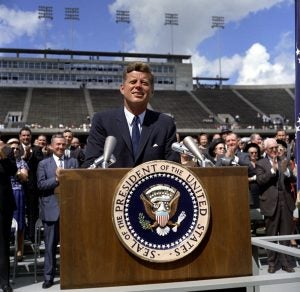
President John F. Kennedy did not spend $5.four billion in 1960s money — what amounts to more than $45 billion today — because he cared about infinite.
"The merely reason he committed the resources to Apollo that he did was that he saw Apollo as a forepart in the Cold War," Dreier said.
The big spending boost NASA got went away not long after Neil Armstrong and the other astronauts returned to Earth. President Richard Nixon welcomed Armstrong and the Apollo 11 crew back in 1969 , and there were half-dozen more Apollo missions. But by the very adjacent twelvemonth, in 1970, Nixon cut NASA's upkeep by hundreds of millions of dollars and said it was no longer a special program. Like any other part of government, human space flight would take to compete for resources.
That'due south why Poppy Northcutt, who worked at Mission Control during the Apollo program, chosen it a pleasant memory, only too sad and bloodshot. NASA already had plans for more ambitious missions to the moon and Mars, she said, and she wishes they could accept done those too.
"In Congress' mind, and mayhap in the public listen too, they viewed it every bit a race, a race with the Russians, and once the race with the Russians was won … there was non annihilation more than to do," Northcutt said.
NASA's budget remained low for decades. The agency'due south crewed infinite missions stayed in depression earth orbit ever since, about one-thousandth of the way to the moon — like going a few blocks rather than traveling beyond the country.
Then in 2003, the space shuttle Columbia broke apart above the globe'due south atmosphere, killing the vii crew members. Dreier said the disaster fabricated the White Firm and Congress reflect: Why do we send humans into space? Why are they risking their lives?
After that massive setback, President George Westward. Bush came up with a assuming new mission for NASA, perhaps with the thought that if lives are going to be put at risk with infinite exploration, we might also shoot for the moon. The goal: return to the moon by 2020, live and work on the lunar surface, then go to Mars and other planets. NASA called the plan Constellation.
Then-NASA Ambassador Michael Griffin called it " Apollo on steroids. "
NASA got to work on a bigger rocket, a lunar lander three times larger than the 1 for the Apollo missions. The Hawkeye was on the moon for a few hours. This one would stay a full calendar week.
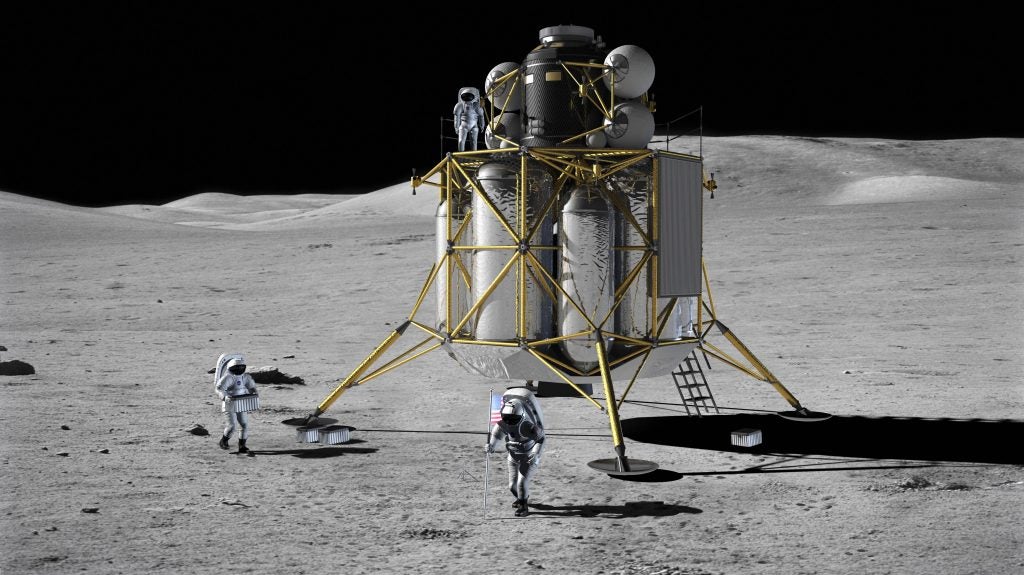
In 2008, Eugene Cernan, the last astronaut to walk on the moon , visited the Johnson Space Eye in Houston. NASA was already in the final stage of the design process for the lunar lander. Kathy Laurini, projection managing director, remembers Cernan telling her team to add together something that would brand being in space a little more pleasant for the astronauts:
"When you're on these missions, yous're far away from earth, and y'all're roughing information technology upwardly, you don't have a great identify to sleep, it's hard to go to the bathroom … what would really have been overnice is to exist able to wake up in the morning and have a prissy hot cup of coffee," Laurini said.
So it came equally a total shock when the Obama administration canceled Constellation in 2010. Charles Bolden, the NASA administrator at the time , described it as "a death in the family."
Some space analysts, to this 24-hour interval, say Obama "ruined space exploration" and "expressed an contempt to American exceptionalism." Only Dreier noted that Obama inherited the plan from George W. Bush, who promised an Apollo-sized program but could non pair it with Apollo-sized funding.
"The political back up for that initiative never really materialized. And by the time the Obama administration came in, they were looking at a program that was billions of dollars over budget, years backside schedule, and information technology was unclear what level of success they could expect out of that and win."
After Constellation, Dreier said NASA got smart and decided to build something that would work, more or less, no matter where the next president wanted to go: a large rocket and a coiffure capsule that could stay in space.
"You can send it to the moon, yous can probably send it to an asteroid, maybe through some modifications, you can send things to Mars, just you don't need to start over every iv years," he said.
There'due south as well something NASA doesn't like to talk about because it removes the romance of infinite travel: the infinite program is a giant chore-creation program.
NASA shouldn't be shy well-nigh it, Dreier said — it's part of the big picture, and information technology's how space exploration gets paid for.
"NASA is i of the purest expressions of human curiosity that we meet in the unabridged world," Dreier said. "What other government agency has fans like this? You don't see the Department of Agronomics having people call themselves agriculture fanatics."
People buy NASA T-shirts, pins and hats because space exploration is cool. That'south why we make moving-picture show after motion-picture show about the astronauts, the gripping human drama, life and decease stakes, but we don't picket movies about the politics of paying for it.
Source: https://whyy.org/segments/why-havent-we-gone-back-to-the-moon/

Post a Comment for "Why Havent the Us Landed on the Moon Again"