High Volume Oil Pump 2010 F150 54 Review
If y'all're building or modifying an engine, information technology's a procedure that requires a lot of planning and forethought. Y'all need to know how the engine will be used. At what RPM do you want your powerband to exist prevalent? What camshaft should you order, and do you need a high-pressure or high-volume oil pump?
That last consideration is a question I go asked quite often, and the oil pump is non a slice of the project that should cause confusion. To assistance clear the air, I reached out to Mike Osterhaus VP of aftermarket products for Melling Engine Parts and Certified Lubrication Specialist, Lake Speed Jr., at Driven Racing Oils to go some curtailed input.
Nonetheless, earlier we hear from the professionals, we need to get a few things straight. First, oil pumps produce flow, and the flow restrictions within the engine are what build the pressure level. However, a force per unit area-relief valve in the pump actually regulates the commanded pressure. If your engine is experiencing low oil pressure, information technology is usually acquired by a leak or excessive wear in the engine (call up oversized bearing clearance or worn bearings as an example of a leak). When this occurs, many enthusiasts believe adding a loftier-volume pump volition help.
"A high-volume pump will increase the flow to the engine, which will provide an increase in pressure. The amount of the improvement depends on the amount of wear in the engine or the size of the leak," states Osterhaus. Simply, you still have the leak or worn condition. Loftier-book pumps are designed to be used when increased demands on the oil arrangement — such as loftier RPM usage, racing, remote filters, and/or coolers — are added.
Pressure Versus Menstruation
Permit's consider pressure versus flow inside an engine. The size of a given oil pump is designed to supply the correct corporeality of oil to meet engine requirements. It produces a specific amount of menses at a given RPM. The resistance to the oil'due south flow is from the diverse clearances within the engine (i.eastward., bearing and lifter bore clearances).
I'm comfortable with 20 psi at a hot-idle. That is sufficient pressure level when the engine is not under load. – Lake Speed, Driven Racing Oil
When an engine is freshly built, the clearances are tight, and the oil pressure is good. As the bearings and lifter bores wearable, clearances increment. When this occurs, resistance to flow decreases, and oil force per unit area starts to drib. "It is normal to see a reduction in the operating oil force per unit area equally the engine wears over fourth dimension," affirms Osterhaus. When the pressure drops, we get our commencement bespeak that something is wrong in the engine. With the increased clearances/decreased resistance, the flow from the oil pump is at its maximum.
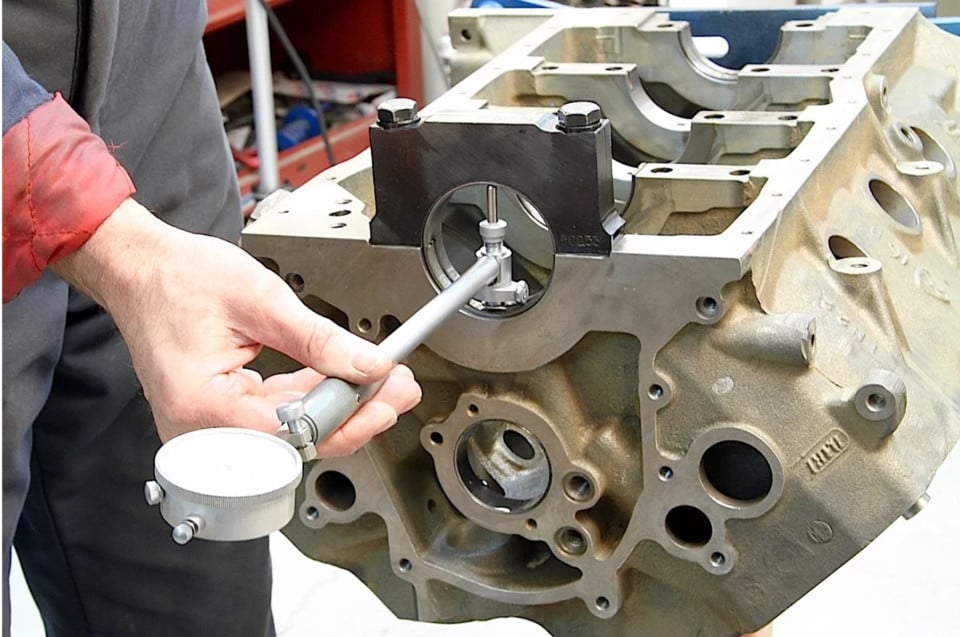
Traditional thinking has bearing clearance for street and most functioning applications at roughly 0.001-inch of clearance for every i-inch of crankshaft periodical diameter. Another thing to continue in listen isbearing clearance establishes the viscosity of theoil to apply within a givenoil-temperature range. Generally, the tighter thebearing clearance, the lower the oil viscosity the engine can safely handle.
If bearing clearance is excessive in any location other than rod bearings, the oil pressure will be uniformly low throughout the entire RPM range. If the rod bearing clearances are excessive, the oil pressure volition be low at idle and so go lower as engine RPM increases. This is because rod bearings move in a circumvolve rather than on an axis. This means they are subject to centrifugal forces trying to remove the oil away from the bearing.
"Bearing clearances in the engine will have the largest effect on oil demand," states Osterhaus. "As the clearances increase, so will the engine's demand for oil. If an engine is built with stock begetting clearances, then a stock-book oil pump will work best. We demand to look at increasing oil menstruation from the pump if the engine has larger bearing clearances, higher catamenia-rate lifters, or the improver of piston and/or valve jump oilers, etc. Whatsoever modifications that will increment the engine's demand for oil will require a high-volume pump."
From an oil supplier's viewpoint, Speed recognizes how bearing clearances affect the conclusion, but also explains how the lubricant itself plays a vital role.
"Let's begin with the definition of proper lubrication — having the right oil (correct viscosity and additives for the application), in the right places, at the right time, and in the right amount," says Speed. "Now, besides consider oil pressure is a result of restrictions to oil flow throughout the oiling organization. It is possible to accept very-loftier oil force per unit area with very-little oil catamenia. Just a side notation, viscosity is as well resistance to flow, so the viscosity of the oil itself obviously plays a role in oil force per unit area."
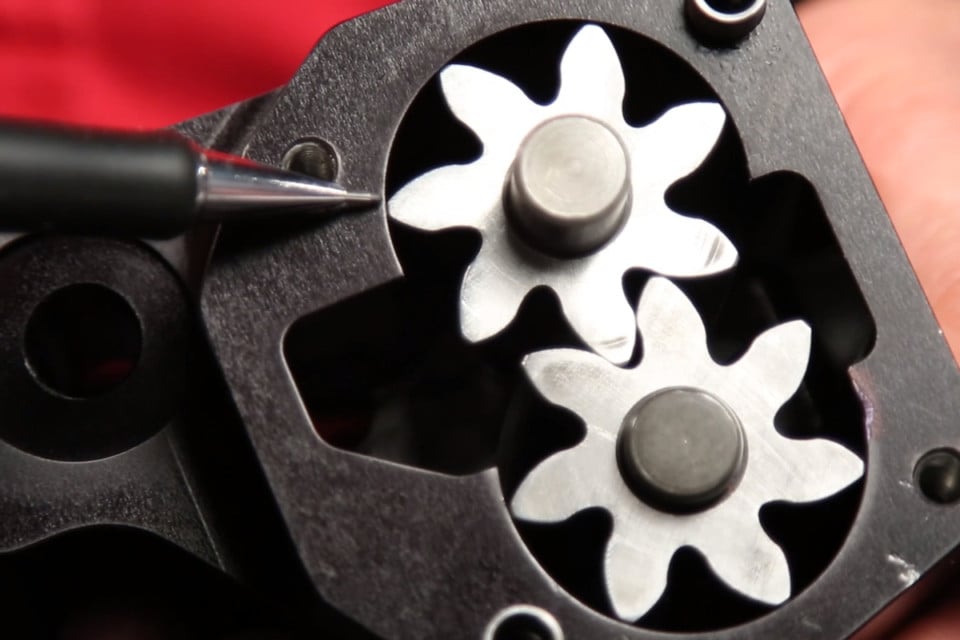
As the engine spins, the meshed gears inside the oil pump also spin, creating period. The pressure of this catamenia is regulated past a spring-controlled valve in the oil pump.
"Consequently, information technology is critical to have proper oil volume moving through the system. Even so, oil pressure level is as important, peculiarly in hydraulic lifters and camshaft-position phasers. Without proper oil pressure level, these devices can't function correctly. Bottom line? They are both of import. It is a both/and human relationship instead of an either/or."
Stock (OE replacement) oil pumps are typically sufficient for apply in near stock applications. But, leave the world of stock, and some are not upwardly to the task. When building an engine to deliver increased horsepower, engine RPM, or has the stock bearing clearances altered to be more uniform with a thicker – or thinner – viscosity oil, choosing the correct oil pump is crucial.
"The awarding always dictates the hardware needs," states Speed. "Higher engine RPM volition increase the pump speed, which tin can lead to pump cavitation. OE pumps are not typically designed for engine speeds beyond the OE red line. As such, engines modified to turn higher RPM demand to be equipped with pumps capable of that RPM."
The flow and force per unit area of engine oil created by the oil pump need to fit the parameters of the application. There is an old dominion of thumb that an engine needs near 10 psi of oil pressure for every one,000 rpm. That guideline is yet a practiced rule to follow. However, in that location are exceptions to the rule. "I'm comfy with 20 psi at a hot-idle," says Speed. "That is sufficient pressure when the engine is not under load." Osterhaus agrees with the 20-psi dominion.
We've heard that many NASCAR teams actually run every bit little as five psi for every 1,000 rpm. Of course, NASCAR engines don't spend much time idling. Consequently, the pump's output book and pressure tin be minimized to deliver just enough oil to keep the engine lubed without wasting excessive power to drive the pump.
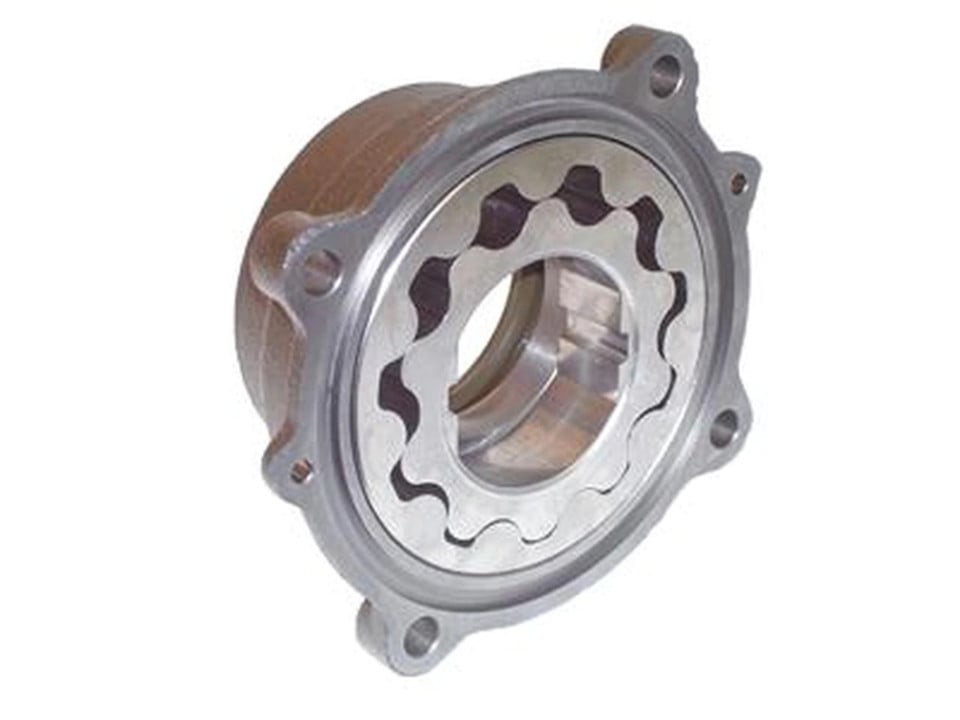
A Geroter pump works when the fluid passing through the pump enters the suction port between the rotor (inner gear) and idler (outer gear). The close tolerance betwixt the gears acts as a seal between the suction and discharge ports. This seal forces the liquid out of the discharge port.
By comparing, an engine congenital for street use spends a lot of time idling and running at low RPM. Because of that, the oil pump has to deliver good flow and pressure level at all engine speeds. Parasitic horsepower draw is less of a concern when discussing a street engine, and that's why many street-use oil pumps are prepare to over-deliver oil to the engine. Many enthusiasts encounter this every bit a way to provide insurance confronting a surprise drib in oil pressure which might damage the engine.
High-Book Pumps
Have you ever heard of people installing high-book pumps in loftier-mileage engines to "gear up" low-idle oil pressure and/or valvetrain noise? A loftier-book pump tin certainly be used for such purposes. But, if an engine has depression-idle oil pressure level problems and/or valvetrain noise, there are other issues that need to be addressed. The business could be excessive bearing clearances, force per unit area losses inside the oiling system itself, or possibly oil-flow restrictions to the upper valvetrain.
Installing a high-volume oil pump has improved the performance of many of our client's high-mileage engines." – Mike Osterhaus, Melling Engine Parts
"A high-pressure pump is an oil pump with a college pressure relief valve setting," states Speed. "There are three means to increase oil pressure: i) Increase the viscosity of the oil (college viscosity means greater resistance to flow). 2) Increase the pump size, which increases oil catamenia. Consequently, oil pressure (resistance to period in the oiling system) will increase. And, three), increase the pressure level relief-valve setting, which reduces drain from the pump itself."
I asked both men if they would always recommend a high-volume or high-pressure level pump as a band-aid for low oil force per unit area. "Not necessarily," Speed states. "Information technology is better to find out the reason for the depression oil pressure. Since oil pressure is a result of resistance to the flow of oil through the oiling organization, information technology is vital to understand why at that place is less resistance than normal. It is also important to consider the viscosity of the oil as a factor."
"One of the primary "leak" points in an engine are the master and rod bearings. Larger clearances provide larger areas to leak, which bleeds off oil pressure. Driven Racing Oils publishes a bearing clearance-to-oil viscosity chart that helps engine builders, racers, and enthusiasts cull the correct viscosity oil for their begetting clearances."
According to Osterhaus, "the increased internal clearances plant in a high-mileage engine create a higher need for oil. A high-book pump will provide assistance in increasing the oil flow to fill up the larger internal clearances. This results in increasing the oil pressure. Installing a high-volume oil pump has improved the performance of many of our customer's high-mileage engines."
High-volume oil pumps accept taller gears and typically flow well-nigh xv- to 20-pct-more oil than a comparable stock pump. In some applications, a high-period pump is absolutely essential. Many late-model engines with cylinder deactivation (some LS engines) require more than oil flow for the lifters and cam phasers, and so these parts tin do the job properly.
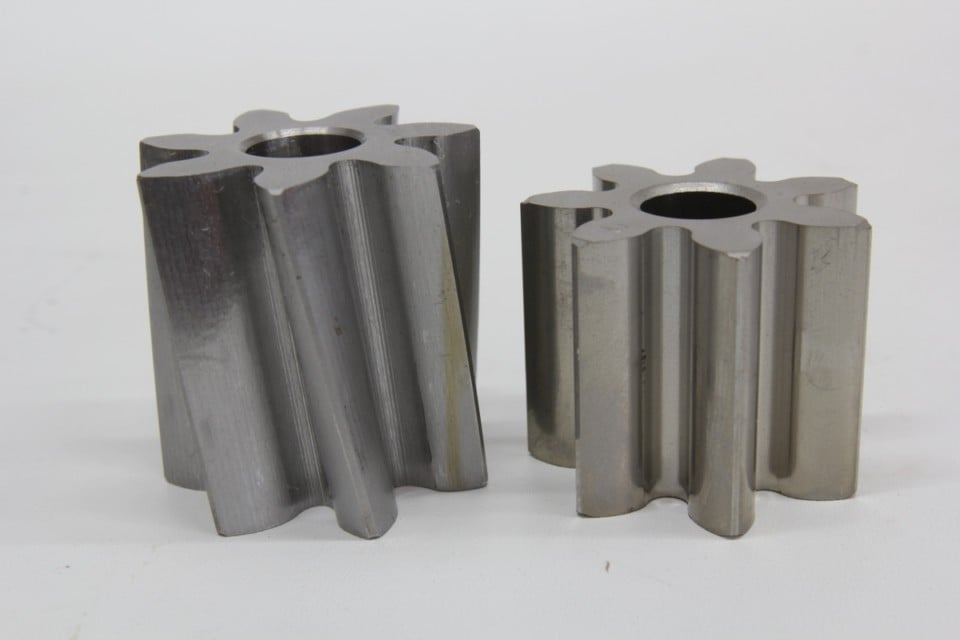
A high-volume pump has a larger gear than a standard-volume pump. The gear on the left is Melling's new shark tooth gear, while the gear on the correct is a traditional straight-cutting gear.
A high-volume oil pump is also necessary if you're building a operation engine with larger bearing clearances (more than .0025-inch at the main and rod bearings if using 20W-50 racing oil). On the other paw, if y'all are building an engine with tighter main and rod-bearing clearances, the engine won't demand equally much oil volume, and a stock-chapters pump should work but fine. The pressure level was not addressed, only volume.
A Stock Pump Has its Place, But…
I of the limitations of all oil pumps is a condition called cavitation. At some speed (dependent on oil viscosity), the gears within the pump volition really exist spinning faster than the oil tin can menses through the pump. When this limit is reached, small bubbles course along the abaft edges of the gears. This is cavitation.
This status aerates the oil and causes the pump's fluid-output to stall. For many stock, directly-cut, spur-gear oil pumps, cavitation tin occur when the engine exceeds 6,000rpm. With front-mounted or crankcase-mounted gerotor-manner oil pumps (think LS), cavitation may occur at a somewhat college engine RPM.
It'south no surprise that minimizing cavitation is paramount. Oil-pump manufacturers have adult various pump designs that can reduce cavitation at higher engine speeds. One upgrade is to overstate the oil-pump inlet and use a larger diameter pickup tube. This volition let oil a less-restricted period into the pump. By doing and so, it can keep up with the increasing speed of the pump's gears. Another pattern found in some racing pumps will carve up the inlet stream into two channels and road half to each side of the gears.
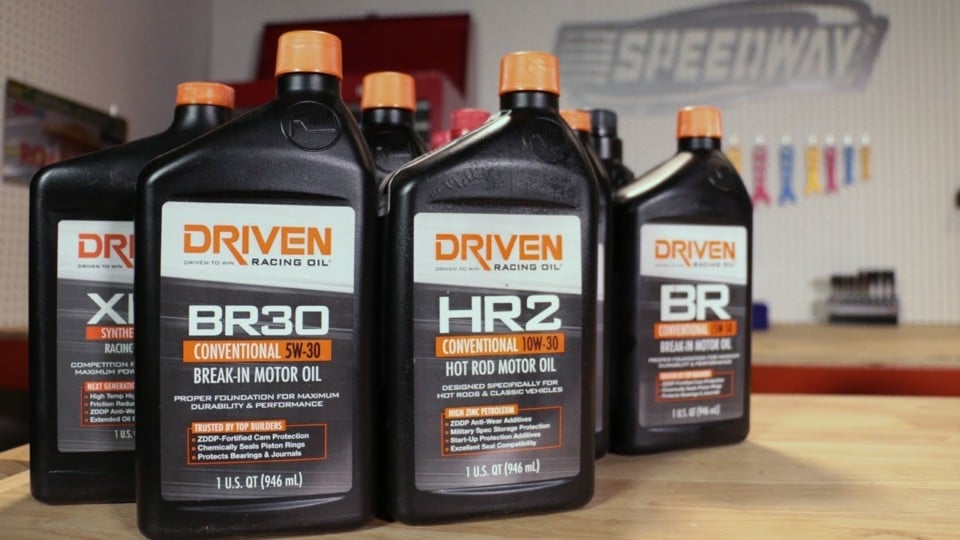
Not only do you need a quality oil, only the viscosity plays a crucial role in oil force per unit area. Driven'due south high-performance motor oils are formulated using Pennsylvania petroleum combined with high-zinc (ZDDP) content that has been engineered and tested to deliver increased horsepower and better engine-wear protection under high load. Driven oils are available in various viscosities for high-functioning engines.
"OE pumps are designed to meet the original statement of requirements for a particular engine while decision-making cost and weight," states Osterhaus. "Melling is non constrained past these requirements and is costless to pattern and produce a pump that will provide improve performance across the engine's operating range. The OE manufacturers accept investigated applying certain coatings to the pump's internals, but have decided against using them, as they increment toll — fifty-fifty though durability is increased significantly."
Co-ordinate to Speed, an engine's operating range is the largest consideration to keep in mind. "The awarding always dictates the hardware needs. Higher engine RPM volition increment the pump speed, which can lead to pump cavitation. OE pumps are typically non designed for engine speeds beyond the OE redline. Every bit such, engines modified to plow higher RPM demand to be equipped with pumps capable of that RPM."
Not All Pumps Are Created Equal
Front-mounted oil pumps — like those on Chevy's LS, Ford's modular engines, and Chrysler's Hemi have a few advantages and disadvantages when compared to in-pan-mounted oil pumps. On the plus side, these front-mounted pumps are a gerotor-style pump that offers better oil-flow characteristics than traditional in-pan pumps with a direct-cut spur-gear pattern.
Front-mounted pumps are also driven by the crankshaft, which means it rotates at engine speed, which is actually twice the speed of an in-pan, crankcase-mounted pump that is driven by a shaft geared to the camshaft or benefactor. The front end-mountain design also ways there'southward no driveshaft spinning the pump that can flex, twist, bend, or break.
A disadvantage of a forepart-mounted oil pump is that information technology is mounted above the actual oil level in the pan. We must keep in heed, oil tends to drain out of the pump rather quickly when the engine stops running (shut off). This leaves the pump "dry out" during the next startup. In-pan mounted pumps are continuously submerged in oil, and this helps retain oil inside the pump. This fact makes it much quicker and easier to self-prime and build oil pressure when a cold engine is started.
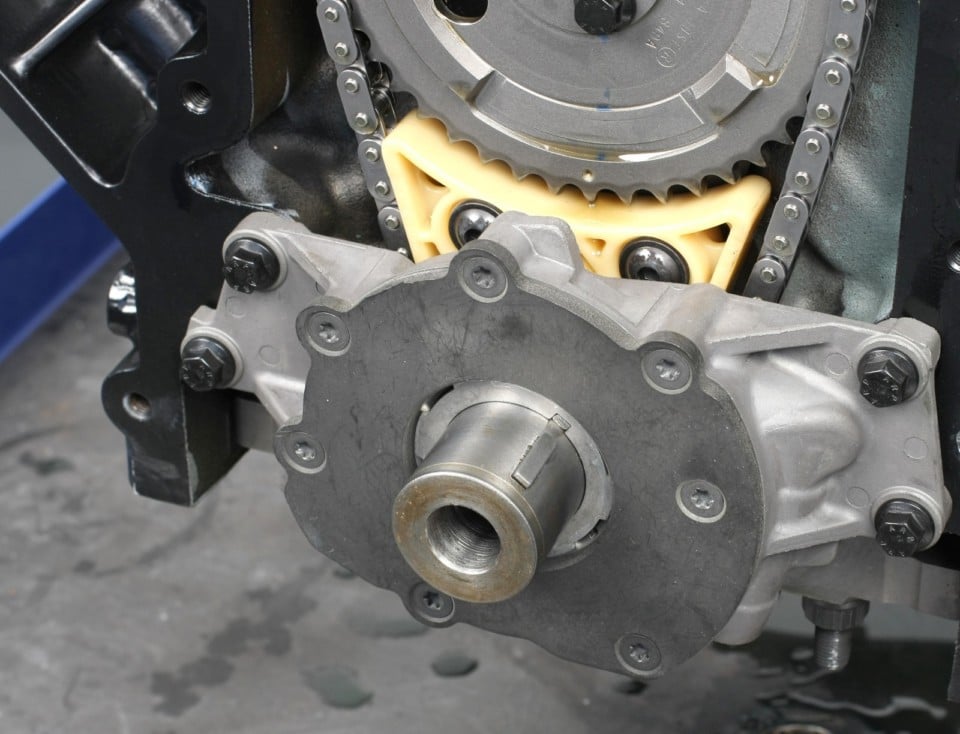
Front-mounted oil pumps practise have benefits when compared to in-pan-mounted oil pumps. On the plus side, these front-mounted pumps are a gerotor-style pump that offers ameliorate oil-period characteristics. A downside of a front-mounted oil pump is it is mounted above the oil level in the pan. Since oil tends to drain out of the pump rather rapidly when the engine stops running (shut off), priming takes longer during startup.
Some other downside is pick-upwards tube mounting. A front-mounted pump uses a relatively long selection-up tube to connect to the oil in the pan. In theory, this means a front end-mounted pump will take more time to self-prime and generate oil pressure during a common cold start. While this time is minimal, it could cause problems — peculiarly if using heavy viscosity oils.
New Oil Pump Innovations
Recently, there take been some innovations in oil pump design that addresses many of the central bug that plague traditional oil pumps. Oil pump suppliers like Melling are constantly striving to amend its products to deliver improve performance and more reliable functioning. 1 of these evolutions is a design change that reduces cavitation at college engine speeds.
While a typical in-pan oil pump uses straight-cutting gears to pump oil through the engine, Melling released a new gear design that resembles a shark'south tooth. The technical jargon for the new gear is a helical-asymmetrical gear.
Helical gears utilize teeth that are cut at an bending and have a slightly forward rake. While a directly-cut gear immediately meshes at full contact, the angled teeth on a helical gear gradually go engaged with one another. This results in a quieter and smoother functioning. The smoothen-meshing of the helical-asymmetrical gears reduces cavitation equally compared to the straight-cut gears.
Hopefully, this look at book versus pressure level has given you some insight into knowing what pump is best for your application. There are a lot of variables that can impact how much oil volume or pressure a pump tin deliver. For that reason, it'due south about impossible to say a high-volume or loftier-pressure pump is correct for a blanket application.
Source: https://www.chevyhardcore.com/tech-stories/engine/oil-pump-selection-is-high-pressure-or-high-volume-better/

Post a Comment for "High Volume Oil Pump 2010 F150 54 Review"